
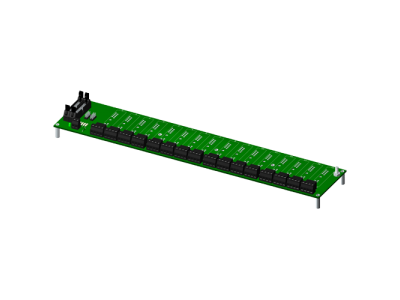
SCMPB02

isoLynx Analog I/O Expansion

Dataforth

  • 16 Module Slots
  • 16 Analog I/O Channels
  • Expandable with SCMPB02/06 to 60 Analog I/O Channels
  • Expandable with SLX101 to 128 Digital I/O Channels
  • 1500 Vrms Isolation
  • Panel or DIN Rail Mount
  • CE Compliant

Details

The SCMPB02 16-channel backpanel (Figure 5) can accept any of the SCM5B analog modules in any mixture. It can be mounted on the SCMXRK-002 19-inch metal rack. The SCMPB02 has two analog buses; one for analog input and one for analog output. This two-bus configuration takes advantage of the switch controlled outputs on the input modules and the track-and-hold inputs on the output modules. A temperature sensor is mounted on each channel to provide cold junction compensation for thermocouple input modules (see Figure 6 for schematic). Field connections are terminated with four screw terminals at each module site. Up to four SCMPB02 backpanels may be daisy-chained. Use SCMXCA004-XX cable for daisy chaining and connecting to host computer.

Specifications

Family
Dataforth isoLynx
Unit Type
Module
Slots
16
Max Throughput
3.6 kS/s
Resolution
16-bit
Min Temperature
-40 °C
Max Temperature
85 °C

Models

SCMPB02
16 Channel, Analog I/O Backpanel
SCMPB02-1
16-channel backpanel without cold junction compensation circuits and standoffs for mounting.
SCMPB02-2
16-channel backpanel with DIN rail mounting option. The backpanel is mounted on a plate which is captured by the SCMXBExx DIN rail mounting elements.
SCMPB02-3
16-channel backpanel without cold junction compensation circuits and with DIN rail mounting option.

Downloads

SCMPB01-07
SCMPB02, Analog I/O Backpanel
AN101 RMS_Voltage_Current
AN121 RiseTime vs BW
AN126 Tuning_Surge_Tank_Level_Control_Loops
AN128 RMS Revisited
AN129 Harmonics and utility costs
Hysteresis Specifications
Faraday's Law of Induction
Data Acquisition Systems Accessories
Signal Conditioner Surge Withstand Capability
Signal-to-Noise Ratio, SNR
Signal Conditioning Measured vs Combinational Error
When Good Grounds Go Bad
Sample Test Report
Why Should Sensors Be Isolated