
8B modules are an optimal solution for monitoring real-world process signals and providing high-level signals to a data acquisition system. Each 8B39 module accepts an input signal from a non-isolated source, then isolates, filters, and converts the signal to an analog process current output.
Signal filtering is accomplished with a 3-pole filter optimized for time and frequency response which provides 60dB per decade of normal-mode rejection above 100Hz. One pole of this filter is on the system side and the other two are on the isolated field side.
A special output circuit in the 8B39 module provides protection against accidental connection of power-line voltages up to 40VAC continuous. Clamp circuits on the I/O and power terminals protect against harmful transients.
The modules are designed for installation in Class I, Division 2 hazardous locations and have a high level of immunity to environmental noise.
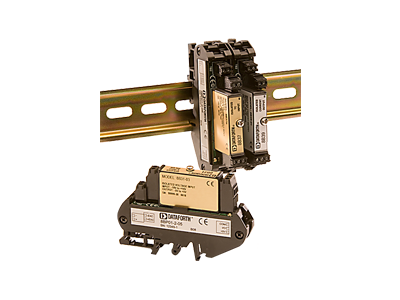
8B39
Voltage Input Current Signal Conditioner Output Modules
Dataforth
- Current Output Module
- 1500 V Transformer Isolation
- ANSI/IEEE C37.90.1 Transient Protection
- Input Protected to 240 V AC Continuous
- Output Protection to 40VAC Continuous
- ±0.05% Accuracy
- ±0.02% Linearity
Details
Specifications
Family
Dataforth 8B
Input Type
0 - 5 V DC
±5 V DC
±5 V DC
# of Inputs
1
Output Type
0 - 20 mA
4 - 20 mA
±20 mA
4 - 20 mA
±20 mA
Bandwidth
100 Hz
Isolation
Yes
Supply Power
5 V DC
Models
8B39-01
0-5 V Input, 4-20 mA Output
8B39-02
± 5 V Input, 4-20 mA Output
8B39-03
0-5 V Input, 0-20 mA Output
8B39-04
± 5 V Input, 4-20 mA Output
8B39-07
± 5 V Input, ± 20 mA Output
Downloads
8B39
8B Accessories
8B Signal Conditioners Overview
8B Module Diagram
AN101 RMS_Voltage_Current
AN105 Resistance Temperature Detector V2
AN121 RiseTime vs BW
AN126 Tuning_Surge_Tank_Level_Control_Loops
AN127 OP-Amp Errors, another View
AN128 RMS Revisited
AN129 Harmonics and utility costs
Hysteresis Specifications
Faraday's Law of Induction
Data Acquisition Systems Accessories
Signal Conditioner Surge Withstand Capability
Signal-to-Noise Ratio, SNR
Signal Conditioning Measured vs Combinational Error
When Good Grounds Go Bad
Why Should Sensors Be Isolated