
Due to the technology employed in potentiometric displacement sensors, they always operate with a sliding contact system. Special processes are applied to give the resistance tracks low friction, low tendency to stick/slip, resistance to abrasion and long-term stability.
The driving rods are guided in long-life, low-friction sliding bearings with close tolerances; this results in highly precise measurements. Transverse forces reduce the service life and can be avoided by using, for instance, ball joint couplings. Due to the pimp effect, the driving rod has double sliding bearings. All the figures quoted in the data sheet for non-linearity, service life, reproducibility and temperature coefficient apply to the use of the sensor as a voltage divider with a maximum current of 0.1uA.
A ball joint coupling (see accessories) at the end of the sliding shaft minimizes axial errors between the sensor and the equipment.
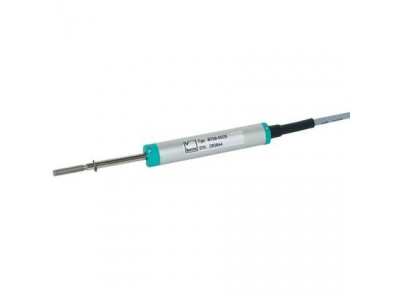
8709
Miniature Potentiometric Displacement Sensor
Burster Praezisionsmesstechnik Gmbh
- Miniature
- Rod-Style Design
- Anodized Aluminum Housing
- Connection: 1.0m Integral Cable
- Very Long Service Life
- Coupling with Ball Joints or Flange Fastening by Request
Details
Specifications
Type
Potentiometer
Full Scale
25 mm [0.984"]
50 mm
75 mm
100 mm
125 mm
200 mm
250 mm
50 mm
75 mm
100 mm
125 mm
200 mm
250 mm
Output
Potentiometric
Non-Linearity
±0.05 % FS
±0.10 % FS
±0.20 % FS
±0.10 % FS
±0.20 % FS
Resolution
0.01 mm
Excitation
0 - 20 V DC
0 - 40 V DC
0 - 60 V DC
0 - 40 V DC
0 - 60 V DC
IP Rating
IP60
Min Temperature
-30 °C
Max Temperature
100 °C
Models
8709-5025
8709-5050
8709-5075
8709-5100
8709-5125
8709-5150
8709-5200
8709-5250
Downloads
8709 Mini Potentiometric Displacement Sensor
Related
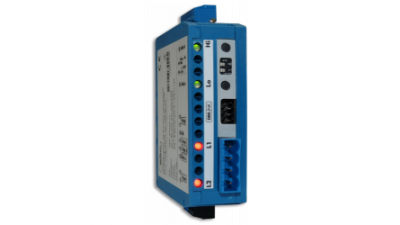
The OMX 380 model range are very fast digital transmitters to DIN rail with and Teach-in function. Modifications available are PM, DU and T. The instrument is based on a single chip microcontroller, 24-bit A/D and 16-bit D/A converter, which...
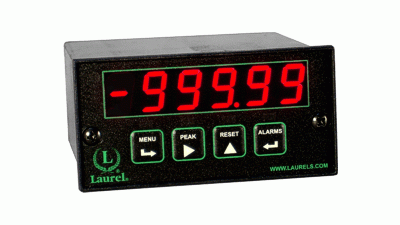
Laureate™ DC voltage and current panel meters with a DC signal conditioner board combine high accuracy with high read rate and a wide range of isolated output options for computer interface and control. Accuracy is 99.99% of full scale ±2 counts.